by Alex Gonzalez
Last week, Trump referred to protestors in New Mexico displaying the Mexican flag as “thugs.” But was he labeling them as such simply because he assumed they were Mexican immigrants based on the flag they carried? What if those protestors were, in fact, American citizens—residents of New Mexico whose families have lived in the region longer than Trump’s family has lived in the United States?
New Mexico has the highest percentage of Hispanic residents of any state, many of whom trace their roots back over 300 years in the American Southwest. For them, the Mexican flag represents a deep cultural heritage and historical resilience—not a rejection of American identity. Yet, for some reason, the image of the Mexican flag continues to provoke political outrage and demands for loyalty, as if acknowledging one’s cultural history is somehow un-American.
There is no excuse for violence at political rallies, and those seeking to highlight the dangers of Trumpism to American democracy must do so peacefully. However, the mere presence of a Mexican flag should not lead to assumptions that anti-Trump protestors are undocumented immigrants or “Mexican thugs.”
In fact, many serious conservative scholars and policy-oriented thinkers have long argued that the greatest threat to constitutional principles and the legacy of American conservatism is not a flag—but Donald Trump himself.
Nevertheless, predictable voices in right-wing media—such as Mark Levin, Sean Hannity, and Michael Savage—are once again stoking fear, warning that the Mexican flag and so-called “illegal” protestors pose a threat to American society. This is nothing new. These figures have built careers by demonizing Mexican Americans, many of whom are U.S. citizens, and by portraying Mexican culture as something that inherently undermines American identity.
Sure, Trump wants to portray these protestors as “Mexican thugs” because his overtly anti-Mexican rhetoric reinforces, for his followers and sympathetic media personalities, the notion that anything associated with Mexico is inherently negative. This pattern was evident when he claimed that a federal judge was biased against him solely because of the judge’s “Mexican heritage.” It also surfaced in his attacks on then–New Mexico Governor Susana Martinez, a Mexican woman.
By associating the Mexican flag with criminality and “bad Mexicans,” Trump is recycling an old tactic that plays into the nativist belief that the Mexican flag is a “foreign” and anti-American symbol.
For Mexican Americans—many of whom are U.S.-born and have lived in the Southwest for generations, and proudly display the Mexican flag—this is about much more than any single election cycle. It reflects a deeper cultural identity and history. To them, anti-Mexican rhetoric is a familiar tactic used by politicians who seek scapegoats instead of taking responsibility for their own failures. It is all too common to blame “the Mexican”—even when that Mexican American family has been in the United States for four or five generations.
Moreover, both Mexican Americans and the Mexican flag have become convenient political targets for those unwilling to acknowledge that Mexican heritage is an essential part of the American story in the Southwest. Despite a complex and sometimes difficult history in the Southwest, Mexican culture is, undeniably, American culture too.
But why is the Mexican flag seen as more provocative or controversial than other foreign flags? In American politics, many ethnic groups have used their ancestral flags as symbols of pride, resilience, and identity—tools for building community and political influence. These expressions are often praised when displayed by European or other immigrant groups. Yet when Mexican Americans wave their flag, it’s often met with suspicion or outright hostility.
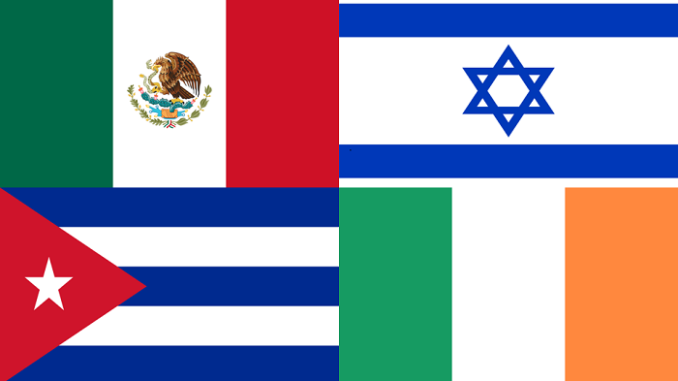
This contradiction is particularly stark among critics who come from “ethnic white” communities that once used the flags of their “old countries” (Irish, Italians, Jews, Cubans) to build political movements and demand recognition. Somehow, their flags are seen as extensions of American patriotism—symbols of ethnic strength—while the Mexican flag is framed as anti-American or evidence of civic decline by many so called conservative and Republicans.
So let’s not pretend the Mexican flag is the only “foreign” flag seen at political rallies. The real question is: Why does it provoke such strong reactions—especially from some conservative circles?
Some historians argue that the cultural animosity toward the Mexican flag in the United States has deep historical roots. Part of it stems from the legacy of the Mexican-American War, but it also traces back to the post-Civil War period when Southern white Confederate veterans settled in Texas and other parts of the Southwest. These settlers brought with them entrenched racial and cultural prejudices. During this time, many Mexican Americans were rendered “foreigners in their own land,” often losing property and political power to the influx of Anglo settlers.
But why is the Mexican flag—present in American history far longer than many flags associated with European immigrant groups—still perceived as more threatening or controversial?
Consider the widespread and uncontroversial display of Irish flags in political rallies, particularly in East Coast cities with large Irish American populations. Politicians in these districts, including many Republicans who often express outrage over the use of the Mexican flag, regularly embrace the Irish flag as a symbol of cultural pride. Ethnic pandering is accepted—celebrated even—when it involves flags from European ancestry, especially when those communities represent a significant voting bloc.
No one in conservative circles seems offended when politicians use Irish identity—steeped in diaspora politics and, historically, opposition to British rule—as a rallying point, even when those views may have conflicted with American foreign policy. Yet the Mexican flag, despite its deep historical ties to the Southwest, is treated as a provocation.
This contradiction highlights the inconsistency in how ethnic symbols are treated in American political discourse—and raises important questions about whose culture is deemed acceptable in the public square.
The Irish lived as a conquered people in their own nation, with Britain controlling Ireland’s political, economic, and religious life. This subjugation and strife gave rise to a strong and unmistakable Irish identity. When they came to America, their deep sense of cultural cohesion enabled them to mobilize and organize effectively to achieve their goals—even when doing so sometimes involved political corruption.
“Their organizational ability coupled with the large number of Irish living in U.S. cities, made the Irish a powerful political force. They literally transformed politics in American cities by putting local power in the hands of men of working class origin. Building on principles of loyalty to the individual and the organization, they built powerful political machines capable of getting the vote.
Political machines controlled major American cities into the 20th century. From New York to San Francisco, the Irish dominated big city politics. New York’s Tammany political machine was under Irish control for more than fifty years.
Irish-American political clout led to increased opportunities for the Irish-American. Looking out for their own, the political machines made it possible for the Irish to get jobs, to deal with naturalization issues, even to get food or heating fuel in emergencies.”

In the 1970s, even Irish-American politicians and political organizations openly raised funds to support the Irish Republican Army (IRA), despite the fact that both the U.S. State Department and the British government had labeled the group a terrorist organization. Yet, no one called for the removal of the Irish flag from political discourse or questioned its presence in public demonstrations.
Similarly, the Israeli flag is frequently used in political contexts to garner support from Jewish voters and donors, particularly among religious conservative groups. These groups have effectively used the symbolism of the Israeli flag to rally Evangelical support for Israel—demonstrating how a “foreign flag” can be strategically and successfully employed in American political rallies without controversy.
In the 1970s, even Irish-American Politicians and political organizations raised funds to help the Irish Republican Army (IRA), despite that fact that the State Department and the British government labeled this group as a terrorist organization. Yet, nobody demands use of Irish flag in politics be removed from politics.
I am a strong supporter of the pro-Israel political lobby known as AIPAC because there is much that Mexican-Americans can learn from its strategic advocacy. The broader question, however, remains: why are certain “foreign” flags accepted in American political discourse, while others are demonized?
Cuban flags, for example, are regularly flown in South Florida during protests related to Cuban politics. Cuban-American activists are among the most ethnically assertive and politically mobilized groups in the U.S. They have learned that by organizing and creating public pressure—including street demonstrations—they can influence both local officials and members of Congress to maintain policies favorable to their community, particularly those aligned with the views of older, more militant Cuban exiles. These protests often feature Cuban flags waved openly and proudly, and at times aggressively, in front of politicians who disagree with their positions—yet this rarely provokes the same backlash seen when Mexican flags are displayed.

When other groups display their ethnic flags—be they Irish, Jewish, or Cuban—no one labels them “thugs,” nor are they accused of being anti-American. Should Mexican-Americans, who have lived in the U.S. for generations, start demanding the deportation of Cubans, Irish, or Jews every time their ethnic flags appear at political rallies?
Why, then, are these cultural and political demands of loyalty and assimilation imposed so uniquely on Mexicans and Mexican-Americans? Today, the Democratic Party is slowly beginning to embrace the cultural identity and heritage of Americans of Mexican descent. Even former President George W. Bush made efforts to do the same within a Republican Party that once championed Reagan-era conservatism but has since drifted toward big-government populism.
I grew up in the 1990s, a decade when America began to witness the significant growth of the Hispanic population—particularly Mexican-Americans. During this period, so-called conservatives from outlets like National Review and institutions like the Hoover Institution began crafting narratives aimed at demonizing the Mexican flag and, by extension, the broader Mexican-American community. Following President George W. Bush’s immigration reform efforts and the economic downturn of 2008, the Heritage Foundation shifted its stance on immigration, rebranding reform as “amnesty” and becoming a key intellectual supporter of Arizona’s SB 1070.
They coined alarmist terms like “MEXIFORNIA,” suggesting that California was on the verge of turning into Mexico. This fear-mongering was used to justify punitive laws, including restricting constitutionally protected access to public education for children. This line of reasoning—rooted in the myth of a social decline caused by Mexican-American growth—has long been used by self-styled “limited-government conservatives” to rationalize the expansion of government power at both state and federal levels under the guise of protecting “the rule of law.”
In their rhetoric, every major social and economic ill—job losses, crime, the erosion of “American values,” and the so-called loss of “white identity”—was pinned on Mexican-Americans. The Mexican flag, in their narrative, came to symbolize this alleged decay. As a result, vilifying Mexico and the Mexican flag became a convenient political shortcut for opportunistic politicians seeking to rise to power.
In the conservative movement, reducing the Mexican flag to a negative symbol is not just a rejection of Mexican-American cultural identity—it is also an attempt to suppress the political empowerment of Mexican-Americans. Unlike Cuban-Americans—who are geographically concentrated in South Florida and represent only about 5% of all U.S. Latinos—Mexican-Americans make up over 70% of the Latino population and are spread across eight states, particularly throughout the Southwest. They are the only ethnic group with historical and cultural claims to this land that predate U.S. statehood.
To hinder the emergence of a cohesive, cross-state Mexican-American political force—similar to what the Irish achieved in the Northeast—cultural shaming has been weaponized. The Mexican flag is depicted as a symbol of anti-Americanism, anti-Western values, and anti-Christian sentiment, despite the fact that Mexican culture is itself a product of Western civilization and Catholic Christian traditions.
This cultural demonization is exacerbated by the internal dynamics within the Mexican-American community. Older generations, who have lived in the U.S. for decades, often hesitate to fully embrace the newer wave of Mexican immigrants that began arriving in large numbers in the 1990s. This intergenerational tension has made it easier for political actors to shame and marginalize expressions of Mexican identity, including the public display of the flag.
No other ethnic group has deeper historical roots in the U.S. than Mexican-Americans. But their political power—through millions of new voters—is a relatively recent development. The reluctance of some in the older generation to fully accept this evolution only emboldens those who seek to undermine the Mexican-American identity and frame it as something foreign or un-American.
To some degree, it is the insecurity of older generations that still allows political activists to demonize Mexican identity and portray the Mexican flag as something negative or anti-American.
In 1970, the Mexican-American population was approximately 4 million. Today, it stands at around 40 million. The largest wave of growth occurred in the 1980s and 1990s, driven by rapid U.S. economic expansion and the rising demand for services fueled by the baby boomer generation. As a result, unless older generations and cultural leaders take deliberate steps to instill a strong sense of history and cultural pride in the newer generations, political groups will continue to exploit this absence—openly shaming and undermining our heritage.
Some conservative groups with significant political influence understand this cultural vulnerability and use it strategically to suppress Mexican-American identity. In some cases, they even enlist non-Mexican “Latinos” to promote narratives that delegitimize the Mexican-American presence in the Southwest, casting their culture and history as incompatible with conservative values.
Another way the political establishment suppresses Mexican-American identity is by relegating Mexican-Americans to low-level roles—as foot soldiers—without building mechanisms within party structures to elevate them into top leadership positions. The “old guard” often fears that empowering Mexican-Americans could shift the party’s identity to appear “too brown.” As a result, even a dedicated Mexican-American party member may end up voting for a white candidate, perceiving fellow Mexican-Americans as unprepared or unqualified for leadership, simply due to systemic underdevelopment of their political pipeline.
I have long noted that many party leaders and interest groups have a vested interest in bringing in non-Mexican Latinos—often from other regions—to lead organizations comprised primarily of Mexican-Americans. Too often, Mexican-Americans are subsumed under the generalized “Latino” or “Hispanic” labels. These labels are frequently exploited by small, politically active groups—such as some Cuban-American organizations—to claim representation over all Hispanics, even when their agendas do not reflect the priorities of Mexican-American communities.
This “Hispanic” identity is politically constructed, and often lacks the shared historical or cultural experience necessary to create a cohesive political force. Real political power comes from communities that are shaped by a shared culture and struggle—not from artificially broad demographic categories.
This is precisely why, for example, the Republican National Committee frequently hires Cuban-Americans from Florida to lead Hispanic outreach efforts in the Southwest. By sending these so-called “Hispanic” representatives into Mexican-American regions, the RNC hopes to steer local communities toward a party agenda that often fails to speak to their specific cultural history, policy priorities, or lived experiences.
Ultimately, the question comes down to how Mexican-Americans view themselves—as integral contributors to this country—and how they assert that identity within political structures. Unfortunately, this cultural hesitation and lack of assertion is most evident in politics, even as Mexican-Americans continue to play vital roles in every other sphere of American life.
And that is the premise of Tomas Jimenez’s book Replenished Ethnicity: Mexican Americans, Immigration, and Identity. It explains why Mexican-Americans still struggle with their identity here in the US and why sometimes the cultural exigencies cultural of “loyalism” in political circles make them hesitant to embrace the millions of New Mexican-Americans.
Jimenez of Stanford in his book Replenished Ethnicity: Mexican Americans also argued that even though American society discriminated against the descendants of these early Mexican immigrants because of their ethnic origin, the children and grandchildren of these immigrants moved out of ethnically concentrated neighborhoods, joined the military, intermarried, and experienced socioeconomic Mobility and do not want to be called “minority’.
But Jiménez also points out that the everyday experiences of Mexican Americans reveal that their ethnic identity is deeply tied to contemporary Mexican immigration in ways that make that identity both beneficial and burdensome. The continual influx of Mexican immigrants helps reinforce cultural ties and fosters a stronger sense of ethnic pride among Mexican Americans. However, this same dynamic contributes to a prevailing perception of Mexicans as perpetual foreigners, which, in turn, casts Mexican Americans as outsiders—regardless of their social and economic integration into American society.
As a result, third- and fourth-generation Mexican Americans may feel ambivalent or cautious about embracing their Mexican identity, fearing that doing so could undermine their middle-class status or be seen as a barrier to full assimilation.
Another great book is by Gregory Rodriguez – Mongrels, bastards, orphans, and vagabonds – and
racial classification an unprecedented account of the long-term cultural and political influences that Mexican-Americans will have on the collective character of our nation. In considering the largest immigrant group in American history, Gregory Rodriguez examines the complexities of its heritage and of the racial and cultural synthesis–mestizaje–that has defined the Mexican people since the Spanish conquest in the sixteenth century.
Thus, el mestizaje, American racial classification, and Jim Crow laws all played a significant role in shaping how Mexican-Americans have struggled with their identity—and how that identity plays out in politics.
But let’s be clear: the cultural demands for loyalism imposed on Mexican-Americans are purely political. They have nothing to do with American ideals, the U.S. Constitution, or patriotism. These demands are largely pushed by rank-and-file party activists and some state party bosses. Many of these figures see the rise of a cohesive Mexican-American political force as a threat to their political status and “whiteness,” fearing that too many “Mexicans” in the Party will make it “too brown.” But this is all party politics.
Moreover, across generations, Mexican-Americans interact fully with each other and share a strong awareness of their common cultural lineage. They hold their Mexican heritage—and their Mexican-ness—in high regard. Yet in politics, especially in conservative circles, Mexican-Americans are often pressured to prove their loyalism by abandoning any public expression of their heritage. Any Mexican-American political leader or cultural figure who wants the community to take charge of its own destiny must instill in younger generations a strong, accurate historical foundation to strengthen cultural identity.
Mexican-Americans—and Mexicans more broadly—do not think in strict racial terms. Their identity is more of an ethnic affiliation, particularly in the U.S. Southwest and in the context of Mexican immigration. About 60% of Mexicans identify as “white,” others as “brown” or mestizo, and some as Indigenous. But in the U.S., this is a cultural-ethnic identity, not a racial one.
I don’t expect non-Mexican Latinos to fully understand why Trump’s overtly anti-Mexican remarks are so vile. Nor do I expect them to understand why, during the 1930s, American citizens of Mexican descent were rounded up and deported under FDR to free up jobs for poor white Americans suffering during the Great Depression. I don’t expect them to understand why Eisenhower’s “Operation Wetback” deported both immigrants and American citizens of Mexican descent to make room for returning GIs. I don’t expect them to grasp why Mexican-American GIs who fought in Europe returned home only to fight again—for the right to be buried with the same honors as white soldiers. These are unique historical injustices faced by Mexican-Americans in the Southwest. Trump’s remarks are particularly offensive to this group because of that deep, specific history.
I don’t expect the so-called “Latinos” preparing to support Trump—so they can be paraded by the RNC and his campaign as evidence of “Latino support”—to speak out against this rhetoric. That’s understandable; many of them are clinging to token political titles or campaign jobs. But for Mexican-Americans, this issue goes far beyond a single election.
For Mexican-Americans, it starts with knowing who we are, what we want, and who we choose to lead and represent our communities. No political party that builds its platform on the demonization of Mexican-American communities deserves our support.
In the Southwest, Mexican-American cultural heritage is a genuine expression of what Jefferson envisioned under the doctrine of states’ rights: the right of states to preserve their own culture. Neither the federal government nor a national political party has the authority to impose a national culture or suppress others—aside from fostering a shared civic culture. Jefferson would have agreed that a cluster of states in the same region has the right to unite in defense of their culture and history, so long as it does not conflict with the Constitution. Therefore, Mexican-Americans have the right to demand that their culture be recognized within any political party they join. We have the right to insist that our history and heritage no longer be scapegoated or labeled un-American or disloyal. When that happens, the Mexican flag will be seen not as a symbol of anti-Americanism, but as one of resilience and cultural legacy.
Of course, there will always be those who oppose Mexican-American political assertiveness. But that is politics. The stereotype of the “bad Mexican” will fade, especially as reverse migration strengthens cross-border relationships. Mexican-Americans and Mexicans in Mexico will increasingly find ways to resolve regional differences and build a cohesive, economically integrated region that benefits both nations. As former U.S. Ambassador to Mexico Tony Garza put it:
“In many ways, I’ve lived a North American life. I grew up in Brownsville, Texas, and like many other towns along the border, I’ve watched it change dramatically over the years. As a kid, nearly 40 percent of my classmates were from Matamoros, Tamaulipas, and I would walk or bike to their houses after school. Even as I got older, I never thought twice about heading across the border to play basketball or football with my friends.
In the 1980s, it stopped being such a quiet place, and now it’s much more difficult to go back and forth across the border. However, these communities remain the spaces where two countries, two cultures, and two languages intermingle every day. They make great places to visit and live and are the obvious starting points as we develop stronger partnerships with our neighbors.”
The Mexican flag is a symbol of resilience, cultural pride, and endurance. What one sees in it depends on one’s perspective, but it is not a symbol of disloyalty to the United States. At a time when even conservative scholars and intellectuals are warning that Trump poses a real threat to American institutions and to 150 years of Republican history, low-level party activists would rather argue that the Mexican flag is the real threat.
But the racial and political demands imposed on Mexican-Americans are nothing new in America’s pluralistic democracy.
The first wave of English Puritans in New England pushed the Scots-Irish into the South, viewing them as too unruly and culturally incompatible with their religious order. The Scots-Irish then settled in the South, where their culture flourished under their own terms. Later, Irish immigrants faced anti-Catholic and racial bias from the Protestant establishment. Eventually, Irish, Jewish, and Italian immigrants clashed in industrial cities, where Irish Americans—having become accepted as “white”—fought to maintain their position by enforcing segregation and excluding Black Americans from economic and political systems. These groups later embraced the privileges of whiteness to uphold those systems.
This is the nature of a pluralistic democracy: groups compete for power under established rules.
Mexican-Americans are not the first ethnic group whose rise threatens the existing power structure. That rise will be resisted with new laws—often unconstitutional—that seek to restrict education access, suppress votes, and block civic participation. But in a pluralistic democracy, Mexican-Americans can still gain power by organizing, voting, and electing leaders who represent and defend their interests across the Southwest. Only when Mexican-Americans master this political game will their culture—and the Mexican flag—cease to be viewed as foreign or threatening to American civic life.
Alex Gonzalez is a political Analyst, Founder of Latino Public Policy Foundation (LPPF), and Political Director for Latinos Ready To Vote. Comments to vote@latinosreadytovote.com or @AlexGonzTXCA